

AI SERVICES
AI Governance Services
WHAT AI GOVERNANCE MEANS
Governance your board can evidence
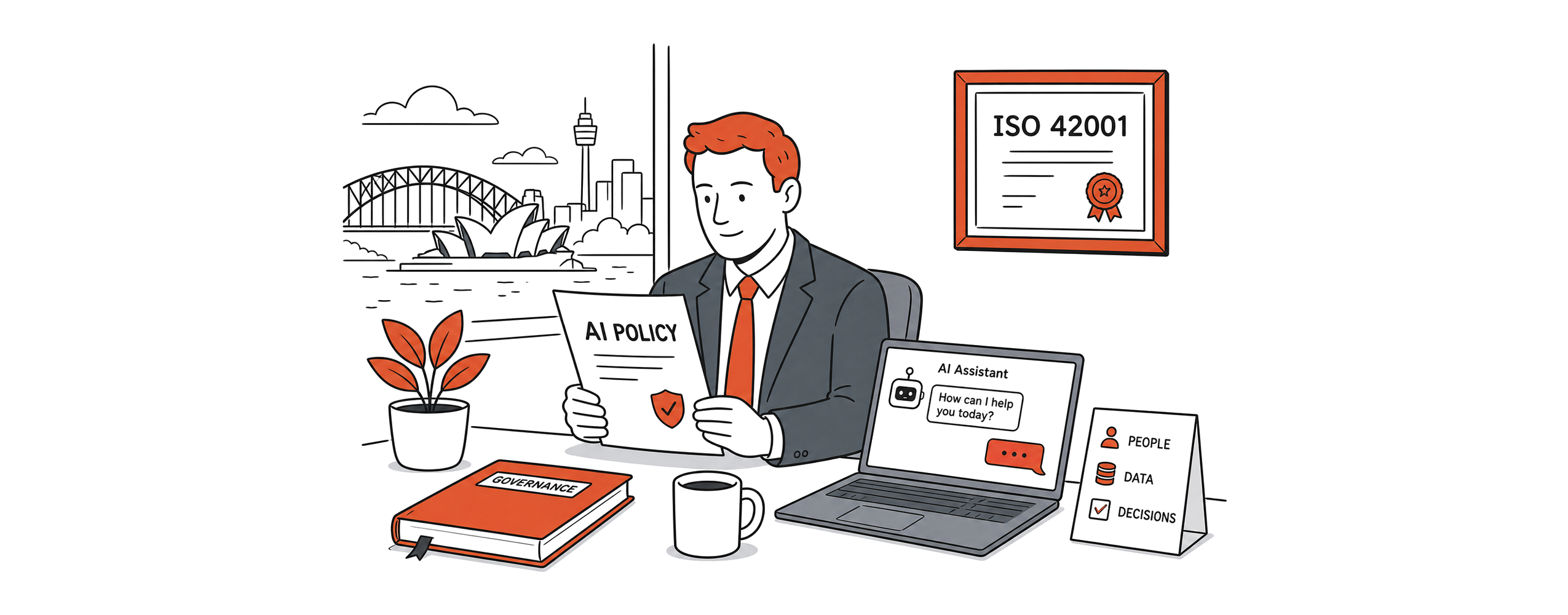
AI governance is the set of controls, policies and records that let an organisation show how AI is being used across its business, what risk that use creates, and what has been done about it.
In Australia there is no single AI law to comply with. The obligations arrive through the Privacy Act, your sector regulator, your insurer and your contracts.
Your staff already use AI. That decision was made in open browser tabs, not in a board paper, and it is not going to be reversed by a policy nobody reads.
The question is no longer whether it is happening. It is whether you can demonstrate, to a regulator, an insurer or a court, that you knew what your people were doing with it and took reasonable steps to manage the risk.
Most mid-market businesses cannot demonstrate that today.
There is a policy somewhere from the year it was signed. Nobody is tracking which tools staff actually use, or what leaves the business inside a prompt. Training happened once.
There is no tool register, no live risk record, and nothing an auditor or an underwriter would accept as evidence. The risks AI introduces are already documented; what is usually missing is the record showing you managed them.
AI Governance as a Service closes that gap and keeps it closed.
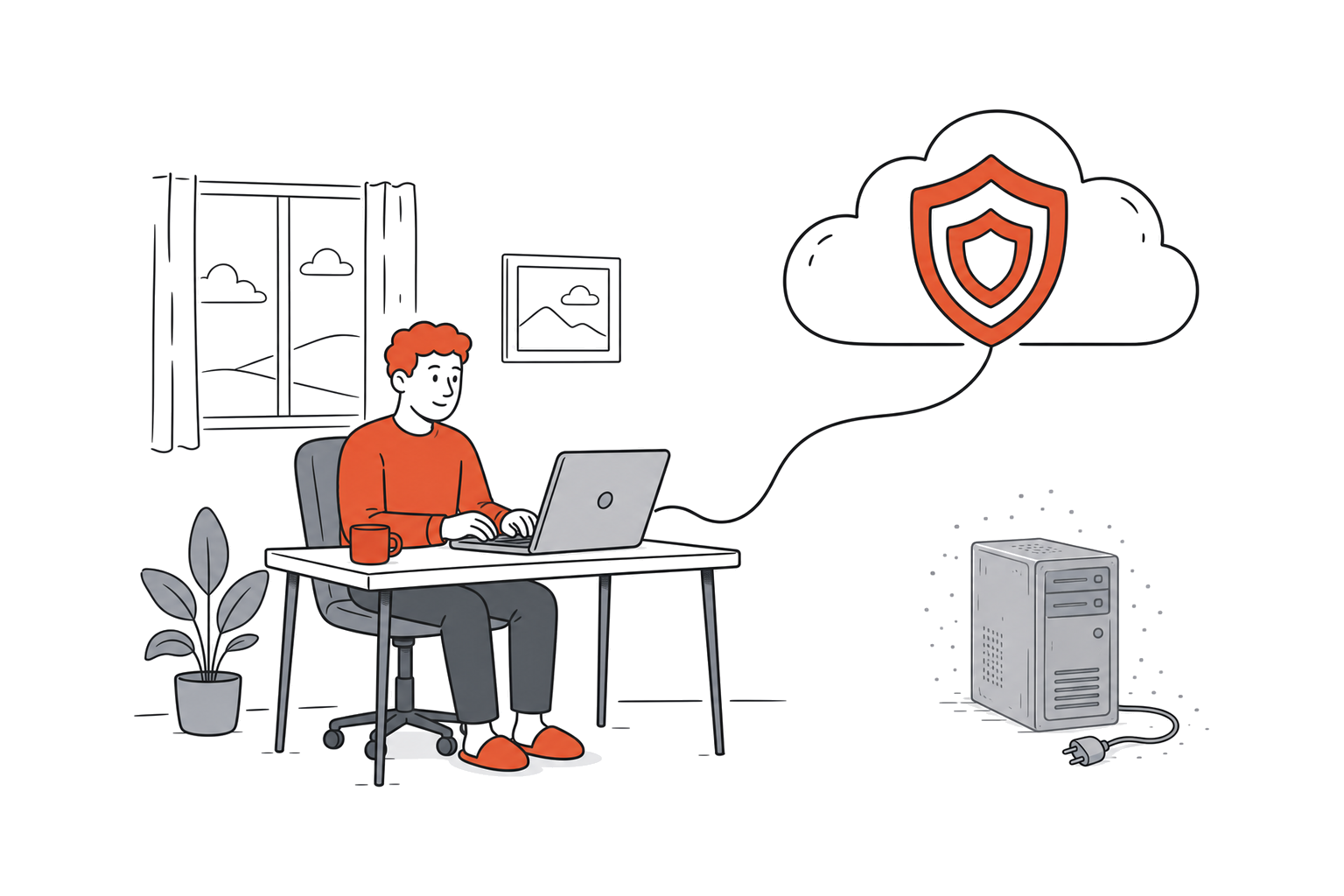
Where the exposure is technical rather than procedural, our AI security monitoring service handles detection at the network layer and feeds what it finds straight back into your governance record.
WHY NOW
Get Started
The governance gap is already open
Three numbers that describe most Australian businesses right now, including yours.
Rapid Adoption
45 %
Regular AI use on work devices, tripled in a year from 15% (Verizon DBIR 2026)
Hidden Use
57 %
of employees keep their AI use from their employer (KPMG & Uni. of Melbourne 2025)
Privacy Act Deadline
10 Dec
2026 automated decision transparency commences under the Privacy Act (APPs 1.7-1.9)

WHAT THE SERVICE DELIVERS
Four parts of
Four parts of
one governance
program
AI governance is one problem, not four separate ones, so we deliver it as one service rather than four engagements. Scope is confirmed at your AI Discovery Session.


Continuous Governance and Compliance Oversight
Monthly Oversight
Every month we audit what AI is actually running in your business, measure it against the obligations that apply to you, and update your risk record. Nothing waits for an annual review.

AI tool usage audit
Sanctioned tools, browser extensions and the AI features quietly switched on inside software you already pay for.

Compliance monitoring
Measured against obligations such as the Privacy Act, AHPRA, Law Society rules, ASIC and APRA expectations, and your own contracts and cyber insurance conditions.

Live risk register
Updated monthly, with incidents flagged and escalated as they surface rather than at year end.


AI Acceptable Use Policy and Staff Training
Policy and People
A policy written for your industry and your actual tools, then kept alive by training your staff complete and you can prove they completed.

Bespoke acceptable use policy
Scoped to your sector, your regulators and the tools your people really use. Not a downloaded template with your logo on it.

AI tool register
The single list of what is approved, what is not, and who asked for what.

Quarterly awareness training
Short modules, updated as the risks change, with completion tracked and escalated so the evidence exists when someone asks for it.


AI Vendor Risk Assessment
Before You Deploy
Structured assessment of an AI tool before it touches your data, ending in a clear recommendation rather than a list of considerations.

Data sovereignty and privacy
Where the data goes, whether it stays in Australia, and how that sits against the Privacy Act.

Contract and training-data risk
Terms of service, model training clauses, liability and jurisdiction, and whether an opt-out is actually enforceable here.

A decision, in writing
Approve, approve with conditions, or do not approve. Two pages in plain language with a technical appendix, kept in your portal for seven years.

Regulatory Intelligence and Advisory
What Changes Next
Australian AI regulation is moving. We track it so your board is briefed before a change becomes a deadline.

Monthly regulatory watch
Privacy Act reform, sector regulators, and international frameworks that reach Australian businesses through contracts and supply chains.

Quarterly plain-language briefing
What changed, whether it applies to you, and what we are doing about it.
Advisory access
Someone to call when a client questionnaire, a tender or an incident asks a question you cannot answer from a policy document.
How It Runs
From exposed to governed
Onboarding takes two to three weeks. After that the program runs on a monthly rhythm, with the board-facing work landing quarterly and annually.
01

Discovery and baseline
Two to three weeks. Nothing is assumed and nothing is taken on trust.
We find what is already running, assess the risk it creates against the obligations that actually apply to you, and set the baseline every later report is measured against.


02

Policy and training rollout
Month one. The policy, the register and the staff communications land together.


03

Continuous oversight and board reporting
Monthly from month two; board-facing work quarterly and annually.

What You Get
What lands on your board's desk
Governance is only worth what you can put in front of a director, an underwriter or an auditor. These are the three artefacts the program produces. Each one is live, dated, and written for the person who has to rely on it rather than for the people who built it. Which of them you need, and how often, is set when we agree scope.
01
 The Register

AI Tool Register and Risk Register
The two documents that answer the first question anybody asks: what are we running, and what could go wrong with it. The register lists every AI tool in use, with an owner and the data it can reach. The risk register records what each exposure means for you, dispositioned as treated or accepted.
-
Every AI tool in use, approved or not, with its owner, purpose and data exposure

-
Every risk recorded, dispositioned as treated or accepted, and dated
-
Established in onboarding and reissued monthly, so nothing waits for an annual review


02
The Report
Board-Ready AI Governance Report
Written for directors rather than for IT. Plain language, no tool names your board has never heard of, and a clear statement of where your AI risk sits, what moved this quarter, and what to do about it before the next meeting. Written against the live risk register, so the board sees the record we work from.
-
Where your AI risk sits this quarter, and what changed
-
Recommendations your board can act on before the next meeting
-
Quarterly, with an annual framework review and realignment


03
The Evidence
Vendor Assessments and Evidence Pack
The file you hand over when somebody asks you to prove it: a client questionnaire, an insurer at renewal, a regulator after an incident, or an auditor midway through a certification. A tool you are considering gets a written assessment first: approve, approve with conditions or do not approve. Behind it sit your policy, training and acknowledgement records.
-
Per-tool assessments with a written recommendation, kept in your portal
-
Policy, training and acknowledgement records, current and dated
-
Assessments on request; the evidence pack maintained and retained for seven years


Together they turn AI governance from a policy nobody reads into a defensible position documented due diligence for a regulator, an insurer or a court, and a board that can show it knew, assessed and acted.
OUR POSITION
Setting the Standard
Your board stays accountable for AI. Our job is to make that accountability something you can show: a live register, a risk record, and the evidence a regulator or insurer will accept.
Ashish Srivastava, Head of AI

THE FRAMEWORK
An AI governance framework built for Australia
Your program runs on a framework built for Australia.
It is anchored to the Australian Government’s Guidance for AI Adoption: the National AI Centre’s six essential practices for responsible AI, published in October 2025 as the first update of the Voluntary AI Safety Standard.
Those practices are what an Australian regulator, insurer or auditor now reads as good practice, and every part of the monthly program maps back to one of them.
Where the international standards add discipline, we draw on the AI management standard and the NIST AI Risk Management Framework. The obligations we hold you to are the Australian ones.
Six practices, four parts of one program
Decide who is accountable sits with your board and your acceptable use policy, and the AI tool register names an owner for every system in use.
Measure and manage risks is the live risk register, every risk dispositioned as treated or accepted. Share essential information is that same register, the disclosures your privacy policy will need from 10 December 2026, and the plain-language board report.
Test and monitor is the monthly audit of what is actually running, not what was approved. Understand impacts and Maintain human control are built into the vendor assessment and the policy, so a person stays in charge of what any tool is allowed to decide.
A mapping you can put in front of anyone
The framework stays in use after onboarding. When your board asks which obligations are covered, the answer already exists in writing: each practice, the part of the program that delivers it, and the evidence behind it.
It tells a director how each risk has been dispositioned, it tells an underwriter that your controls exist and are operating, and it tells a tender panel that your AI answer is documented.
Obligations move, and when they do the framework shows you which parts of your program are affected, rather than sending you back to a blank page.
The standard we hold ourselves to
TechBrain holds ISO 27001 certification. We are separately pursuing certification to AS ISO/IEC 42001:2023, the AI management standard.
We run our own AI program on this framework, to the standard we ask you to meet, which is why the discipline behind your register, your risk record and your board report is the one we already run our own business on.
We are not asking you to adopt a standard we have not adopted ourselves.
FAQ
Who is liable when AI makes a mistake in my business?
You are. Every Australian regulator that has addressed AI has answered this the same way: accountability cannot be outsourced to a tool or a vendor. If an AI system makes a decision that breaches privacy, misleads a client or discriminates, the obligation sits with your organisation, and for material risks your directors carry it personally. A vendor’s terms of service will not move that liability, and in most cases they are written to make sure of it. What changes your position is not a contract clause. It is being able to show that you knew where AI was being used, assessed the risk before deployment, set rules, trained your people, and acted when something went wrong. That is the difference between an incident and a failure of governance.
Who is responsible for AI governance, the board or IT?
The board is accountable and IT is not equipped to carry it alone. AI risk is a business risk: privacy, professional obligations, contracts and reputation, not server configuration. Boards that treat it as an IT matter usually discover the gap when an insurer or a major client asks a question nobody in the building can answer. Where a business also needs executive-level security leadership, our virtual CISO service covers the wider cyber programme.
What does the Privacy Act require for automated decision-making from 10 December 2026?
From 10 December 2026, APPs 1.7 to 1.9 require your privacy policy to disclose where personal information is used in computer programs that make, or substantially help make, decisions affecting an individual’s rights or interests. It is a transparency obligation, so it does not ban automated decisions. It does require you to know where they happen, which for most businesses is the harder part. Practically it means an inventory of the systems involved, including AI features inside software you already use.
Do we need ISO 42001 certification to have good AI governance?
No. Certification is one way to prove a management system exists, not a precondition for governing AI well. See ISO 42001 certification in Australia for what the standard covers.
How is AI governance different from AI security monitoring?
Governance is the compliance and policy layer: what is allowed, who approved it, what the risk is, and what evidence exists. Security monitoring is the technical detection layer, watching for data moving to unapproved AI platforms, prompt injection and AI-assisted attacks in real time. A staff member pasting client data into a public chatbot is a governance failure. A staff member clicking an AI-themed phishing link is a security incident. Most regulated businesses need both, and where a client runs both with us, detection feeds directly into the governance record. Our AI security monitoring service covers the detection side.